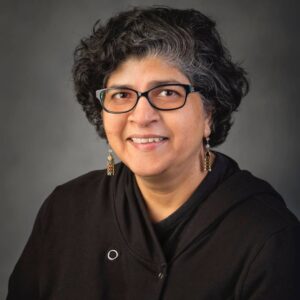
Radhika Gajjala
*Co-sponsored by Communication Arts; Havens Wright Center for Social Justice; Gender and Women’s Studies
Lecture
Probable Realities, Non-existent Archives, Loss, Haunted Hallucinations of Gen AI
Thursday, February 18
Vilas 4070
4 PM
Workshop
#WhyReturn? Let’s explore.
Friday, February 19
University Club Rm 313
12 PM
Lecture Abstract:
Drawing on Anna Munster’s provocation to consider how networks experience and produce new forms of experience, I compare and contrast “Loab”—an AI-generated image emerging through negative prompting—as a counterpoint to Donna Haraway’s liberatory “Cyborg.” Haraway’s cyborg offered a feminist reinterpretation of human-machine entanglements through situated knowledge production while emphasizing material and political realities. Loab, on the other hand, represents what I refer to as “haunted and hallucinatory” (drawing on Lisa Blackman’s concept of haunted data and Ezekiel Dixon-Román’s work on hauntology and algorithmic governance) the presentation interrogates what emerge as outputs through contemporary generative AI (gen AI) systems. These haunted hallucinations rely on the consumption of massive resources while generating mythological imaginaries and misinformation which emulate facts and information.
Interrogating these hauntings and hallucinations, I have been engaged in a series of experiments – provocations drawn from questions raised by postcolonial feminists – using the gen AI imaging tools Midjourney. In order to create a scenario and assert creative autonomy over the output, the experimenting required that I self-learn multiple skills and work with different image editing tools. Questions regarding possibility for user intervention for active production of diverse and intersectional images led me to a series of experiments in producing small vignettes in images and small video clips .
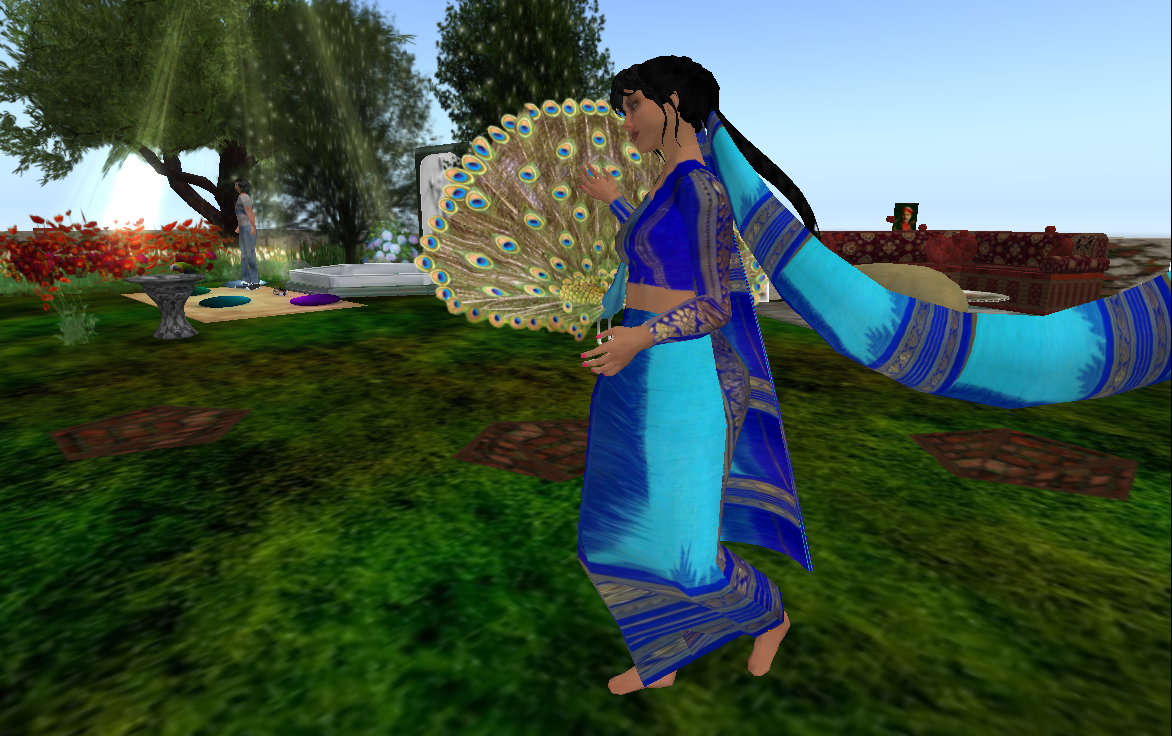
Specifically, I focus on an interchange between the visual selves produced through both the gen AI tool of Midjourney and the in-world avatar from Second Life from my Second Life inventory from two decades ago to iteratively produced variations of “selves” – as images and reels shared via Instagram. The digital artifacts preserved and brought back to “life” in gen AI visualizations represent a kind of digital domesticity and material culture exchange between public platform participation and private, affective identity and memory work.
This personal experimentation with AI image generation, demonstrates how these systems produce “haunted data”—outputs that erase original inputs and generate culturally-coded hallucinations. When the author’s photograph was processed, the AI replaced it with text prompts describing non-existent bodies and places, raising critical questions about evidence and representation. These gen AI hallucinations are haunted by “prompted” and “probable” data.
Workshop Abstract:
Participants will work with an old virtual world environment – Secondlife – and the AI image generator – Midjourney. We will discuss and these explorations in relation to contemporary concerns and theoretical debates around gen ai and autonomy in production of identity in digital environments.
Biography:
Radhika Gajjala, Professor of Media and Communication and of American Culture Studies at Bowling Green State University, and author of Digital Diasporas: Labor and Affect in Gendered Indian Digital Publics (2019), Online Philanthropy in the Global North and South (2017), Cyberculture and the Subaltern (2012), and Cyberselves: Feminist Ethnographies of South Asian Women (2004), as well as co-editor of collections including Cyberfeminism 2.0 (2012), Global Media Culture and Identity (2011), South Asian Technospaces (2008), and Webbing Cyberfeminist Practice (2008); she has served as co-editor of Ada: A Journal of Gender and New Media and continues as Managing Editor of the Fembot Collective. She was inducted as an International Communication Fellow in 2026, received the Francine Merritt Award from the NCA Feminist and Gender Studies Division in 2023 and the Teresa Award from the ICA Feminist Scholarship Division in 2020, and currently serves as Editor of Women’s Studies in Communication while completing a book on Gendered Digital Publics under contract with Rutgers University Press, alongside ongoing collaborative projects extending feminist approaches to computational tools in digital humanities and social science across emerging African and South Asian digital publics, and continuing ethnographic work on “Slipping into Skins” and “#whyreturn” examining how material practices of making translate across offline and digital/generative AI spaces.